Bill de Bass joined the British Army as a Short Service Commissioned officer in 1967. He spent his first couple of years as a Regimental Medical Officer in 1st Regiment Royal Horse Artillery under the benign influence of (then) Lieutenant Colonel Ken Perkins (later Major General and Commander SAF from 1975-1977)
Looking to broaden his experience - and his horizons! - Bill sought a new role and relocated to Queen Alexandra’s Military Hospital at Millbank in 1969 for initial training in anaesthesia. This was followed by a posting to the British Military Hospital in Rinteln, Northern Germany - then the largest military hospital within the area controlled by the British Army of The Rhine.
One of only three anaesthetists there, he provided services for general surgery, a busy obstetric department and the various specialist departments. In March 1972 he was detached to 55 Field Surgical Team in Salalah, formed specially to support operations in Dhofar. Bill cites this as a life-changing responsibility. His experiences in Dhofar - at a critical period and in the most basic, isolated conditions
55 Field Surgical Team in existence in the Spring and Summer of 1972 is my theme.
The aims and objects of an FST were to treat the wounded quickly and as close to the place of wounding as was possible. Pain relief was an important aspect
Obviously this could not occur up on the jebel but could be achieved in somewhere like the protected confines of RAF Salalah
My story starts in an upper corridor at BMH Rinteln which was a 250 bedded hospital in BAOR. I had been a 27 year old middle grade anaesthetist there for about three years. It housed the senior specialists in BAOR covering Surgery, Eyes, ENT and had a heavy Obstetric workload.
I was making my way along a gallery near the Physiotherapy department when I came across a BSM from what had been my first posting as RMO to 1st Regiment RHA.
I listened patiently as BSM McDonagh told me how he had been injured somewhere in the south of Oman.
To be truthful I did not pay too much attention but took most of it on board, wished him a speedy recovery,
Back in theatre I was met by my anaesthetic OTT for the day - Pte Peter Canning RAMC who with an amused grin announced that the CO wanted to see me.
Interview without coffee Sir ? Red light ? Speeding ?
The chief Clerk ushered me into the CO's office where I was invited to
"Sit down Bill. Would you prefer tea or coffee and perhaps a biscuit ? "
The interview was not going the way that Pte Peter Canning RAMC had anticipated.
"You are to be detached to an FST in RAF Salalah in Dhofar. I don't suppose you know where that is ?"
I wished I had paid more attention to WOII McDonagh
Bravely I reassured the CO that I did know where it was provoking his response
"Typical smart-alec anaesthetist who is always several steps ahead of everyone else"
I confessed that I did not know anything about FSTs and perhaps I could visit one to familiarise myself with the setup.
His response was that they were only put together when needed. There were none in Germany or the UK.
The cup of coffee that had been offered in Rinteln was also being offered in other British Military Hospitals : Iserlohn, Woolwich, The Cambridge in Aldershot, Tidworth and Catterick.
I left an unhappy Col Roger and returned to the operating theatre.
He had just lost one of his three anaesthetists for six months. This which would slash his operating capacity by more than 33% and severely cramp the hospital's surgical throughput
There were 30 anaesthetists in the army at that time spread across 13 hospitals. A shortage. There would be no one to replace me whilst I was away.
I tell the ever inquisitice Canning that I am to be detached to Salalah for six months & doubted that he even knew where that was.
"South of Oman sir. There is a guerrilla war going on. Lots of shooting. SAS involved. I wouldn't go there if I were you Sir"
Smart Alec Operating Theatre Technician who is always several steps ahead of everyone else
" Well Pte Canning, as you and I get on well together, the CO wonders if you might like to come with me and hold my hand "
Those of us who were to be unceremoniously snatched from our comfortable postings in BAOR and in the UK were invited to assemble at the skeletal administrative 2 Field Hospital at Mytchett.
We were jabbed with various vaccinations, immunoglobulin - triple dose. We were issued with OGs, given some weapon training and began to get to know each other.
Our new " best friends " RAF Air Movements shipped us as "live cargo" to RAF Salalah where they offloaded us to a dusty shack on the edge of the airfield near the control tower.
We had one day of handover from the disgruntled previous team and they were off. Remarkably it involved me anaesthetising the outgoing consultant anaesthetist so he could be loaded onto the plane. Bad back. They were not unreasonably bored after an uneventful tour.
We felt that we were under some sort of obligation to have a Team Photograph.. We smartened ourselves up and put on our best smiles.
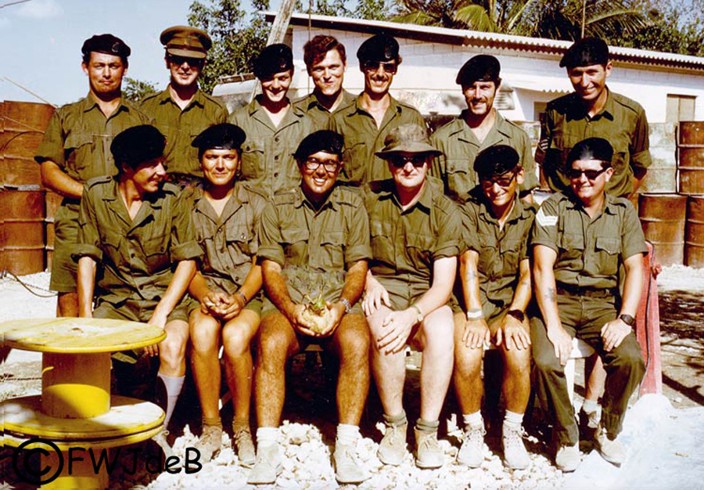
The CO was a charismatic Irishman from Tidworth - Major Joe Johnston - whose particular interest was orthopaedics.
I was the anaesthetist who had the good fortune to have as an assistant a familiar face in the form of Private Peter Canning RAMC
Captain Nick Cetti had been an RMO with the Scots guards, was from Woolwich and was starting his career as a trainee surgeon. He also acted as the camp medical officer which was no small task.
The backbone and core of the FST was manifest in the four operating theatre technicians. It was their job to maintain the operating theatre and ensure that it was ready for use. This mafia was led by Sgt Gerry Farrell who managed the other three; Bud Holder, Pete Starling and Pte Peter Canning RAMC. On reflection they may very well have managed him.
The nursing element was led by Sgt Mick Pargin SRN from Aldershot assisted by Sgt Roger Lynn SRN and Cpl "Mac" SEN
X-ray services were effected by Sgt Roger Hicks who did wonders with a low powered and ancient Mobilex apparatus attached to a domestic three pin plug.
Dave Barrow managed the rudimentary path lab facilities which included our vital blood supply.
Pte Tony Powell was in charge of all the paperwork which included our abrasive communications with Ludgershall.
Ch Tech Brian Spice RAF took the photograph. He was our interface with the RAF. He had, after all, signed for the medical centre.
In answer to "Who we were there to treat ?"
The primary people who we were backing up were BATT.
They were in harm's way, often were injured and naturally required prompt surgical attention.
Here is a list of others we treated.
- British Army and RAF
- SOAF and SAF
- War injured civilians in the FST
- Locals in Salalah Hospital
In addition there were others. One, a matelot from a passing British Merchant ship, who had fallen down a companion way and fractured his ribs.
The other a monkey, Judy the Gibbon, belonging to a SAF officer. Sadly poor Judy died.
Then we then come to the "Elephant in the Room" The man on the hill with the AK-47 and the RCL
Yes we did treat the adoo.
I a list of the injured treated in the FST after Mirbat shows that patients were treated strictly in order of clinical need. Worst injured first, least injured last.
The adoo were assigned their place in the queue according to that clinical need. There was no question of automatically shoving them to the back.
The adoo had been provided with some primitive medical supplies which would have been next door to use less. It was also said that there was a Lebanese doctor on the jebel.
Any adoo with traumatic injuries such as bullet wounds would have had to be " donkeyed " or " camelled " to Hawf and then passed on via Al Gaydah to Aden
Some 99% of our patients came to us from the FST helipad.
The Bell 206 Jet Ranger had capacity for one patient and there was very little space to minister to them.
The more familiar Bell UH-1 or Huey had much more capacity for both patients and medical assistants. Far more useful.
I must, at this point, introduce an American surgeon from Baltimore; R. Adams Cowley. In retrospect he put unnecessary pressure on the medical evacuation chain. In particular on the helicopter pilots.
He was a former military man who had observed that if the time from wounding to surgery was less than an hour, the " Golden Hour ", outcome was improved.
It was in fact not achieved in Oman. I have the figures to demonstrate it. It did however put a lot of pressure on the pilots to fulfil this target
Land evacuation on a donkey's four legs could be a traumatic experience....... In May 1968 Richard John suffered chest and shoulder injuries in the Wadi Hinna 30kms east of Salalah. - He spent 12 hrs on a donkey whilst only having morphine for 3hrs.
The fuzzy photograph taken from a video shows Joe Johnston shepherding Takavesi, who insisted on walking, off the Huey whilst supervised by Neville Baker. Neville Baker had flown to Mirbat, found a very hostile landing area and wisely put him self down back in Taqah to assess damage and wait for things to settle down. Sensibly he had ignored the Golden Hour.
Patients arriving at the FST either went straight into the resuscitation bay or were laid out in the tent to be triaged into an order for operations.
Painkiller was administered. One or more drips were put up and Penicillin and Streptomycin (antibiotic) was given intramuscularly.
Referring to Shakespeare what the fictional Serjeant Williams observed back in 1415 " Blood is the Argument " still held good more than 557 years later.
We had no blood bank but just a rusty fridge. We could not store blood for more than a few hours
Blood however was available all around the camp - " On the hoof" Donors becoming more and more wary of Dave Barrow.
Arrival of a casualty had Dave off around the camp with his hand down shirt fronts after "dog tags"
The Fenwall packs in the rusty fridge had a very short shelf life but beggars can't be choosers.
Next stop is the operating theatre if you would like to call it that. A tent made of "F" sections with an improvised fly sheet and a blower to move the air around.
Inside was equally primitive and clearly not conducive to any sort of major surgery.
Halfway through our tour the Royal Engineers became our saviours and erected a Twynham hut for us. Half was used for resuscitation and the other half as an operating theatre sixteen feet by sixteen feet.
It was much improved on the tent and provided us with air cooled working conditions. We were deeply in debt to the RE Troop who also laid concrete pathways for us and erected dedicated tents for both Dave and Roger.
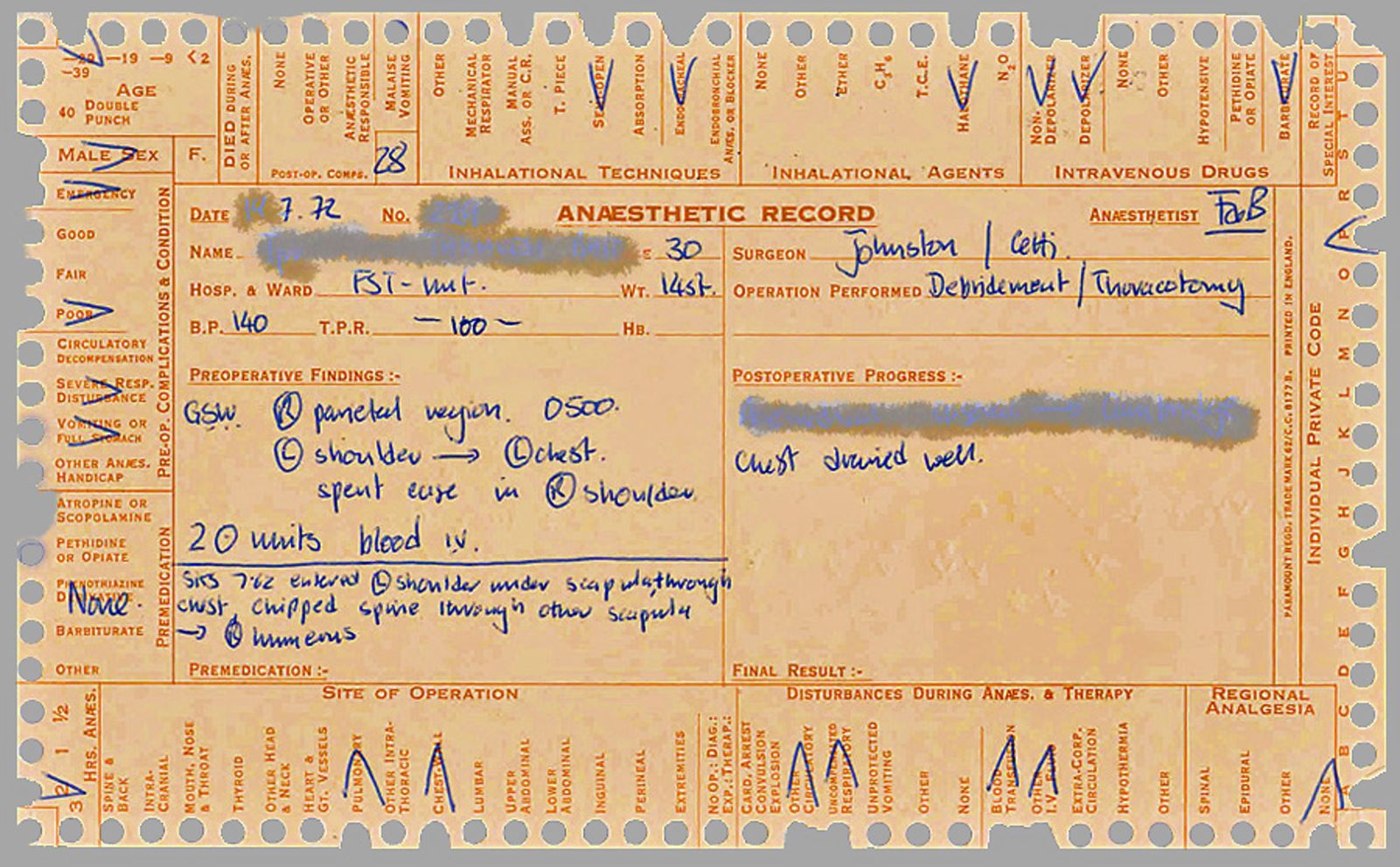
The operating sequence starts with a brief taking of the patient's history. Some of it is left out..
The anaesthetist's Aims and Objects are to render the victim unconscious by bathing his brain with an alkene agent designed to do just that.
The problem is just how you go about it.
First off his mouth is dried with atropine from deadly nightshade which also stabilises his heart - Following this some intravenous thiopentone is used to render him unconscious. It is effective in 45 seconds and consciousness returns after about ten minutes.
There is need to put an endotracheal tube down into his lungs to vaporise the Halothane into his lungs, blood and brain.
The anaesthetist achieves this by using a drug similar to that used by the Russian tourists in Salisbury a few years ago.
Here I would like to introduce Charles Waterton the squire of Walton Hall near Wakefield in Yorkshire. He was interested in science of all sorts and very inquisitive. I have a connection here as I sat in the same classroom as he 150 years later. In 1805 he had been sent to the family sugar plantations in what is now Guyana. There was a ban at the time preventing Catholics from attending the provincial Universities like Oxford and Cambridge so he had to earn a living.
He became interested in the poison that the indians used to tip their hunting arrows.
He brought some home and scratched it into a donkey's shoulder.
The donkey stopped breathing.
It and would have died had he not opened its windpipe and inflated its lungs with air.
We do the same thing now with our own patients
Our paralysed patient has a tube about 8mm in diameter inserted into their mouth in order to place it in the trachea.
If the anaesthetist is a Catholic like Charles Waterton he says a short prayer
" In the name of the Father and of the Son and into the hole it goes " - with apologies to Dave Allen
Anaesthetists are wary of this procedure as some intubations can be difficult. Careful pre-anaesthetic assessment is vital.
My first " Difficult airway " was three months into my training. Col Voller, my trainer, asked me to intubate this stocky six footer whilst he himself read the news paper in the theatre office.
Airways can be difficult if the face is damaged as it was in the case of this lady we called "The Little Old Lady from the West". She had been injured near Sarfait.
Extremely a bad injury to the neck as one adoo might require a tracheostomy.
Having access to the lungs now allows the anaesthetist to pass the anaesthetic agent to the lungs and allow the blood to transport it to the brain. Here,e a good soaking will miraculously place our patient in a condition which satisfies our surgeon. A contraption is needed to do this which consists of a vaporiser, some Oxford bellows and some one-way mica valves and some corrugated tubing.
Oxygen was an added luxury which was generously provided by AirWorks.
In later years fellow SAF Association member Ivan Houghton designed a similar apparatus which was used in all three armed forces.
Returning to our record on the Nosworthy card a note has been made that the injury was at 05:00.
No consent form was signed.
No enquiry about sensitivity to gluten,peanuts or sticking plaster.
Not something you ask a member of BATT with a pain in his backside from a bullet unless you want a crisp answer that takes no account of rank.
The back page reveals that surgery started at 12:40 which is well outside our "Golden Hour". The card tells much about the course of the operation.
Analysis of several cards reveals some gems. For example they reveal that it took 39 hours of back to back operations to treat the 23 wounded from Mirbat. Something that future planners might take into account.
I will now trip through some selected injuries
First an AK-47 which creates a huge shock wave as it passes through flesh.
The entry hole is small. The damage to the bone and blood vessels can be massive. The exit wound is horrendous.
Exploring the entrance wound reveals masses of blackened dead tissue which has to be removed to prevent gangrene .
This adoo, who we put in traction, became very agitated as he thought we were preparing to hang him !
Bullets very often smash bones which is easy to see but they can also do other relatively unseen damage.
There is an entrance hole over his left shoulder where the bullet ended up in his right armpit. The bullet creasing his skull would have created shockwaves which had the possibility of causing serious neurovascular damage even though they did not actually pass through brain tissue
I would like to develop the severity of brain injury from relatively minor to severe. Some of it is of course cumulative.
I played schoolboy rugby with Barry O'Driscoll. We both became doctors but only he became a noted Irish Rugby international
Barry became obsessed with the head injuries that occur in rugby and their long term effects.
I did not play rugby with my CO in Colchester. He persisted in injuring himself whilst taking part in a variety of sports. It was my task to put him right. I advised him to stop playing rugby . He had however compounded his problems by exposing himself to light aircraft engine noise, small arms fire and artillery fire.
It is no secret in the Regiment that he was significantly deaf.
It would not have been career enhancing for either of us had I downgraded him medically.........
Military explosives are in a different ballpark; more violent and more abrupt. The PNM mine contains more explosives than is required to disable a man.
The lower limb may have to be removed and the victim is left with a neat stump.
Airworks did some useful and charitable work by glueing three planks together, turning them on a lathe, attaching some plastic drainpipe and passing them on to me to stitch on a strap.
Satisfied customers. Primitive but it worked; no hinges to harbour abrasive grit.
Large anti-armour mines with perhaps Kgs of explosive offer a vastly greater level of violence. This TM-46 contains 5.75 kgs of explosive which is 20 times the amount in a PNM mine.
Vehicles can be mine plated to give some protection. A mine exploding under one front wheel might leave the person in the opposite seat relatively unscathed.
This slide shows a passenger who was thrown out of the cab having been mined east of Ma'Murah in early May 1972, The massive skull deficit where he landed on his head is obvious. The hole we have bored shows that there was no bleeding and suggests that it was the shockwave that killed him.
He was in essence dead before he came to us.
The short term effects of blast may be obvious. Damage to ear drums, lungs and intestines where solid tissues are adjacent to air filled cavities are less obvious.
Immediate treatment involves debridement, high volumes of oxygen and medications to ameliorate neurovascular damage. If only we had had more oxygen other than a small bottle scrounged from AirWorks.
The long term less obvious effect can be insidious.
An increased level of cardiovascular disease, mental upsets, increased rate of endocrine metabolic diseases such as diabetes.
Some unusual ones like Hypertrophic Calcification.
This is a condition where where abnormal calcification occurs in blood vessels, muscles and tendons above the site of the blast.
The Royal British Legion helped establish and now funds research into blast injuries at Imperial College London This started in 2011 and the armed forces still contribute assistance in kind.
Fragments.
Some weapons, like mortars, can produce medium sized fragments which if they hit a critical area will kill instantly.
This man was killed in early May 1972 at Habrut. His spinal cord had been transected by this fragment.
One of the adoos favourite weapons was the RCL.
One such round hit the edge of the officers' mess patio during an evening drinks party.
Twelve ended up on our operating table including an Air Traffic Controller who had a serious ankle injury but was playing squash several years later.
One well known senior pilot had a penetrating injury to the lower limb which damaged his blood supply and shattered his tibia. The effects were with him until he died in 2004.
The blood supply to his lower foot was especially precarious The abdomen belongs to Pte Peter Canning RAMC
Damage to the tibia was very evident which had also affected the blood supply.
Mortars can also produce many small fragments.
They may look trivial on the surface but x-ray reveals their true extent
The surgery to remove the dead tissue is heroic
Surface peppering requires a lot of debridement including cleansing with hydrogen peroxide.
The question must be asked just how did we dispose of the patients once they were operated on. Immediately they were discharged to the Rainford Ward which was a Twynham hut named after a former RAF SMO.
Here they were looked after by the three nurses until they were well enough to need a less skilled level of care.
The ambulance that BATT had purloined for us was used to discharge civilians to the Royal Salalah and soldiers to UAG where they continued with re-habilitation.
British military were flown to Cyprus. Sometimes this was not successful. Sgt Moores who had received 22 pints of blood in the course of a six hour operation had such a bumpy low level flight evacuation in a C-130 that he died after he was diverted to the Gulf.
We assisted at the RSH both with OutPatient consultations and surgical intervention.
I occasionally administered anaesthetics for their obstetrician.
Our own military hosts were not inclined to make a vehicle available to us. We needed one. If there was an emergency in town we could not hang around filling in a requisition in triplicate. Somehow we acquired a battered LR from the sultan. It was not allowed to run on RAF petrol for some reason.
Indeed the Snowdrops were disinclined to let it into the camp as it "wasn't insured".
The blonde lady from Taylor Woodrow at the the back of the palace cheerfully authorised our refuelling. I'm not sure if the OTTS went to the palace for fuel or filly....
The hospital was packed and the women’s outpatients reeked of frankincense.
The patient is usually on the couch but Joe was Irish ...........
There were some patients who we could have helped had there been skilled post-operative nursing care.
There were some we should not treat. There was no cause to treat a jebali with a large cleft palate as he had got along without any interference since birth.
This man had his symptoms and illness treated with cautery by locals. It was never going to work and he died from a massive gastrointestinal haemorrhage.
I have put this in just to illustrate that there were women’s wards, children’s wards and men’s wards.
There were also opportunities for teaching. Nick and Joe saw things that they would be unlikely to see back at home.
A neatly tiled room was used as an operating theatre. Our small arms were placed on a windowsill in the care of Pte Peter Canning RAMC whilst armed family observers often crowded the doorway.
I occasionally helped train a local anaesthetic assistant. In the absence of an anaesthetic machine we brought our own.
At first glance one lady might seem to be pregnant.
She wasn't but had a massive leiomyoma of the cervix which Joe removed.
This lady had a thyroid tumour which took him three hours.. A portion was sent to the Path Lab in Cyprus for histology.
Gratefully she invited us to her house on the beach for a meal.
Full circle and time for a review
My thoughts are to balance Men and Equipment. If equipment is wanting trained men may very well balance the problem and vice versa.
We were short of basic equipment and resupply was poor. A diathermy apparatus used to stop bleeding - £1000 on Amazon these days - would have cut our operating time in half. The forty hours after Mirbat would have been reduced to twenty.
Scrounging oxygen from Airworks was unsatisfactory. Post blast injury treatment with high volumes of oxygen was vital for an optimum outcome.
Primitive X-ray apparatus made things very difficult for Roger
We needed our own dedicated ambulance. Inferior equipment and supplies makes work harder and influences the quality of outcome
Equipping the man is rather more complex.
The non- officer section of the FST were well trained and were efficient but their workload was increased unnecessarily by their having to use labour intensive methods.
Scrubbing instruments in antiseptic, cleaning and drying them is less effective than an autoclave.
All the other ranks almost to a man had nationally accredited training.
We fell down on both our officer skills and capacity.
The surgeon was well trained, experienced and extremely skillful.
The anaesthetist, myself, was woefully inexperienced and to be quite frank out of my depth.
The junior surgeon was there starting off in his training and also burdened with duties as camp medical officer.
What is not recognised is the wider effect of deploying 55 Field Surgical Team to Dhofar.
There was no replacement for me on the North German plain. The biggest hospital in BAOR, BMH Rinteln, lost 33% of its operating capacity whilst overstretching those who remained behind.
Salalah benefitted at the expense of BAOR and the UK. Manifestly there was early health care co-operation between Oman and the UK.
Histopathology was available in Cyprus.
Some low level training commenced in Salalah.
Some surgical intervention from the FST members for civilians occurred.
Some general advice on medical matters was provided.
It was start of Omani - UK medical co-operation.
Militarily the figures look good as one hundred percent of those wounded who entered the FST alive left it alive.
The quality of outcome measured in terms of residual disability could have been improved.
That backstory is worthy of consideration
Q+A:
What did you do about rehabilitation? Did you have any rehabilitation services after?
No. No, we passed that on. We pushed it on to people in El Gwerth and any rehabilitation for people who were British people, they were evacuated back to the UK. But there wasn't anything set up then at that time.
It must take an incredible sort of mindset to be operating in an environment like that with such a level of natural life and death in your hand. How do you get into a headspace that enables you to operate effectively and how do you translate that perhaps outside of your researching?
How can you, how do you cope with it? I suppose when somebody appears in front of you and they've got serious injuries, you don't think about it, you don't get on with it. That's how you're trained, particularly if you're an anaesthetist who's only called upon when there's a problem. When there's a problem in the hospital, they almost always say call the anaesthetist. And also the surgeon, Joe, who had been a trauma surgeon, if he saw somebody who was particularly badly injured, he just got on with it. He didn't think about it. One of the things that we did, rather than wait until somebody was fit enough for surgery, we just went straight in and did it. You're going to have to operate on them sometime. And how did that help us in the future? I suppose it influenced the way in which we worked in the future in our professional lives.
I remember once being called for whatever 400 miles away to go to the airport at sea to give some blood because I was blood O negative. How on earth do you literally anyone with O negative in the north was told to report to the airport. How did you cope with the daily supplies of blood, which you must have needed?
The daily supply of blood was Dave Barrow going around RF Salalah and taking taking blood from people. He was quiet down the front of your shirt. What does your dog tag stay? I'll have some of that.
What did you do next?
What did I do next? What is the doctor? Oh, I left the RAMC. I stopped being an anaesthetist. I did some obstetrics and for that next 25 years I was not good. I was a GP in Norfolk.