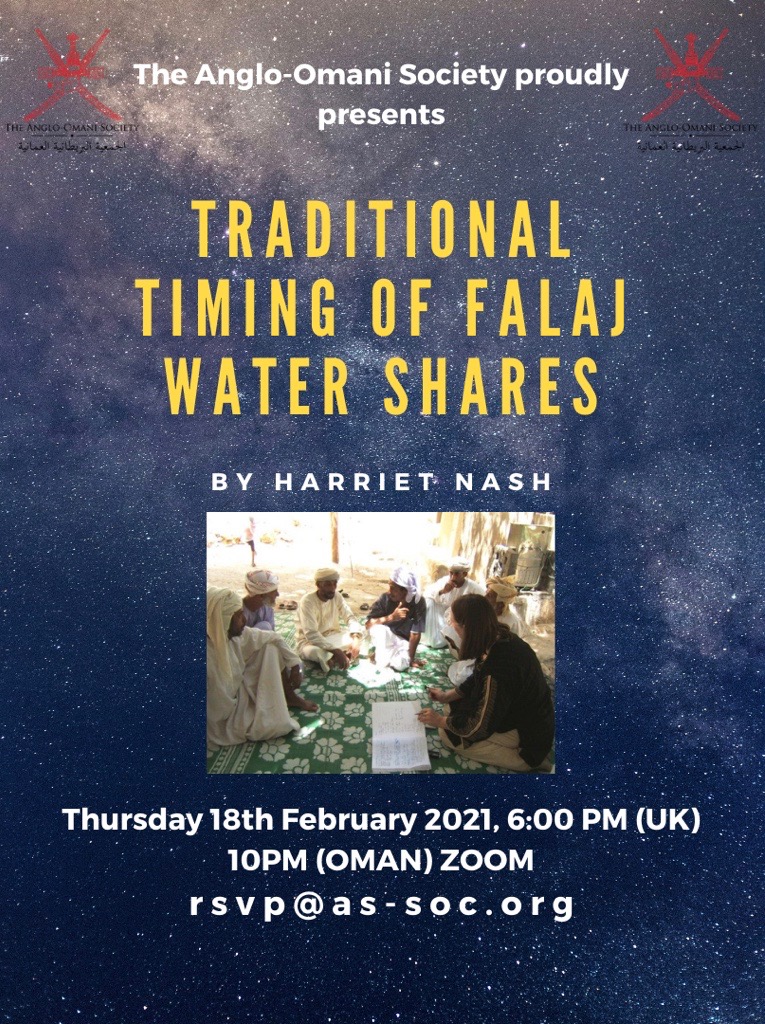
The lecture will describe the research carried out by Harriet on traditional methods of timing falaj water shares, most commonly using sundials by day and stars by night.
A brief introduction to the falaj systems will be provided to establish the context for this practice.
Although many places still use the sundial, star use is almost extinct: in 2006 there were only 11 communities still using them, and now, perhaps only one or two. Without Nash’s research, knowledge of the stars and different methods of watching them could have been lost for ever.
By staying out at night watching the stars with practitioners, and using astronomy software, it was possible to give firm identifications to many of the stars. The marked variation among stars used and their names will be outlined, together with the range of methods used to watch them and thus to time water shares.
The knowledge about stars is part of the rich oral heritage of Oman, and the few written documents were by educated people probably for their own interest, as the falaj star gazers did not need to be literate. However, the two documents that have surfaced, one for Al Hamra’ and one for Falaj Al Hammam at Rustaq, provide a rare record, and the presentation will look at how useful they are in reconstructing the former practice.
Register here
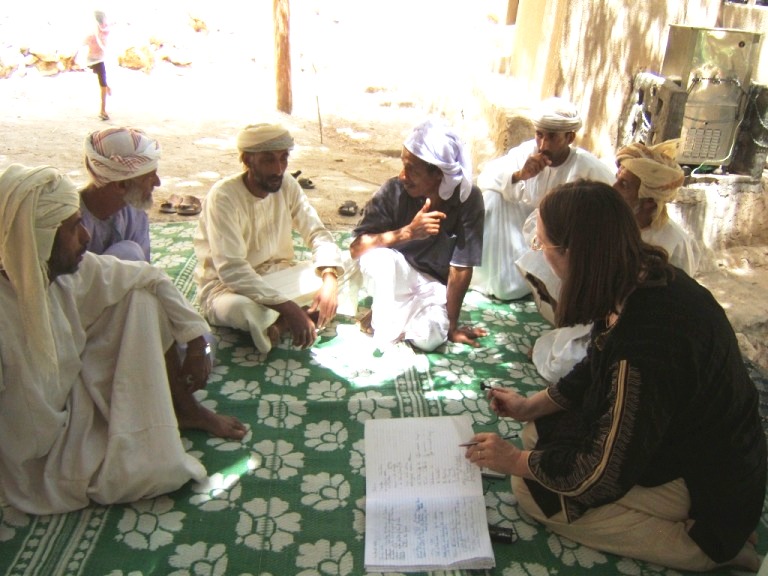
Dr Harriet Nash
Harriet Nash is a hydrogeologist, geographer and ethnographer. Her research on the traditional management of falaj systems, mainly in the Sultanate of Oman, started in 2005. It represents a significant contribution to the knowledge of the oral heritage of star use for timing water shares and is recognised by the International Astronomy Union as important to the World Heritage of astronomy, on the same level as Stonehenge. This research has extended to Qatar and to Iran, where there are similar irrigation systems. Her professional background in hydrogeology, combined with this more recent ethnographic work, brings a unique set of skills to the project, including a thorough scientific understanding of water resources in the region and the problems of climate change and over-abstraction.
She is familiar with the region of Oman, as Director of Dubai Museum in the early 1970s and then as hydrogeologist in Oman, 1974 and 1985-86. She provided expert advice on traditional falaj management to the Al Hajar archaeological project in Oman in 2005. She contributed to Oman’s application for falaj documents to be considered as a Memory of World Heritage and has assisted the UNESCO supported International Center on Qanats and Historic Structures in Iran with its publications.
Before this, she had nearly 30 years’ experience as a hydrogeologist and geographer worldwide, including identification of community needs and resources, liaison among international donors, development of training programmes, facilitating workshops, project management, mentoring of younger staff, development of methodologies and mathematical models, teaching hydrogeology, training in data collection, presentation and assessment, preparation of reports to tight deadlines and budgets.