Blog written by ALS 2026 Participant, Sophie Worrall
At first, I was slightly apprehensive about spending two months in the small town of Manah. Would I feel isolated? Would I get bored? But it didn't take long, once I'd been welcomed by the scorching heat and the sleepy sounds of the town, to realise that the next two months would be about far more than continuing my Arabic studies. What struck me most was the rhythm of life. Away from the pace of everyday routine, I found myself with the rare opportunity to slow down: not only to learn a language, but to become fully immersed in a place, its culture, its history, its people. Looking back, I can see that this slowing down became the foundation of everything I experienced over the following two months.
Learning Through Place
Before arriving in Oman, everyone I spoke to who had visited immediately mentioned the country's beauty, its landscapes, its people. Even with my expectations already high, Oman exceeded them. I soon realised that this sense of tranquillity came from both the warmth of the people and the natural beauty that surrounded them.
The Sultan Qaboos Institute did a wonderful job of ensuring that students got to know the country's diverse landscape, arranging weekend trips to sites of natural beauty and cultural significance throughout our stay in Manah.
One of the first trips, to Muscat, was an early highlight. After two weeks in sleepy Manah, I was suddenly reminded of urban life again. Muscat is undeniably impressive; rather than towering skylines, it offers pristine beaches and whitewashed buildings nestled between dramatic mountains and the sparkling Gulf of Oman, giving the city a calm that feels worlds away from the pace of larger Gulf capitals. Strolling along the shore put a spring in our step, and we spent the evening watching families picnic by the water as the sun set. A trip to the old souk was the perfect opportunity to stock up on gifts, so much so that I had to eventually buy an extra hand luggage to fit all the frankincense, incense, perfume, and clothes I came home with.
.jpg)
.jpg)
.jpg)
From left to right: Shati Al Qurum Beach, Muscat; Souk Matrah, Muscat; Falaj Daris, Nizwa
With Nizwa only twenty minutes from Manah, we made frequent trips to its old souk, ancient fort, historic village, and many cafés. Surrounded by date groves and known for its lively traditional souk, Nizwa offers a glimpse into the cultural heart of Oman.
Our city trips were matched by visits to Jabal Akhdar and a couple of wadis. Perched in the Hajar Mountains, Jabal Akhdar is a highland region known for its terraced orchards and ancient villages. Its cooler air gave us welcome respite from Manah's heat, and its slopes were filled with pomegranates, apricots, and the famous Damask roses that bloom each spring. A gentle hike through the villages, leading towards breathtaking viewpoints, was another reminder of the stillness in the Omani’s nature.
I felt the same on our hike through Wadi Shab, one of Oman's most celebrated natural attractions. A spectacular canyon with palm trees, crystal-clear pools, and hidden waterfalls, it creates an oasis that captures the country's remarkable natural diversity. After that trip, it's safe to say Oman had well and truly won us over with its landscapes.
.jpg)
.jpg)
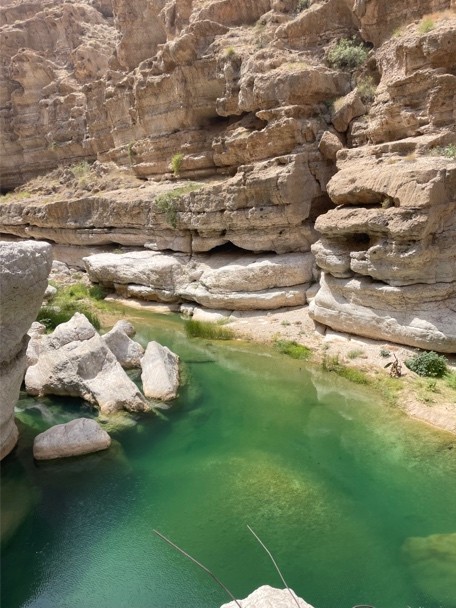
From left to right: Al Ayn Village, Jabal Akhdar; Jabal Akhdar; Wadi Shab
Learning Through People
Travelling around Oman gave me a deeper appreciation of its geography and history, but it was the people I met who gave those places their meaning, and their sense of tranquillity.
One of the highlights of the programme was the Institute's language partner scheme, which paired international students with Omanis. What began as a chance to practise Arabic in a more natural setting than the classroom quickly became something more. My conversations with my language partner ranged across family, traditions, culture, and hobbies. I was apprehensive at first about not being able to express myself properly, but the relaxed, welcoming environment put me at ease, and before long my Arabic began to flow more naturally. Through initiatives like this, the Institute builds real confidence in its students, something I believe is one of the most important parts of learning any language.
.jpg)
.jpg)
From left to right: Abdullah bin Hamad Al Sibani Pottery, Bahla; Birkat al Mouz
The same sense of patience and encouragement was present inside the classroom. Omanis are known for their calm, patience, and kindness, and the teachers there embodied all these qualities. Stillness isn’t only in Oman's landscape, but it lives in its people, and perhaps most of all, in our teachers. The Institute’s staff always took the time to check in with us and made sure we were happy, healthy, and, most importantly, enjoying ourselves. Their passion for Arabic was obvious both inside and outside the classroom, and every student's progress by the end of the course is a testament to their dedication.
Learning Through Stillness
Looking back, I understand now why the Institute is based in Manah. In fact, I’d say it's one of the programme's greatest strengths. We are so rarely without distraction and outside noise, and this Institute creates a rare space to step away from both for a couple of months. I didn't realise how much that would shape my studies until it did. Suddenly I could focus. I could understand more clearly why I was studying Arabic and what I wanted from it. Learning through stillness opened up a space I didn't know I needed, one in which to grow, both in my studies and in myself.