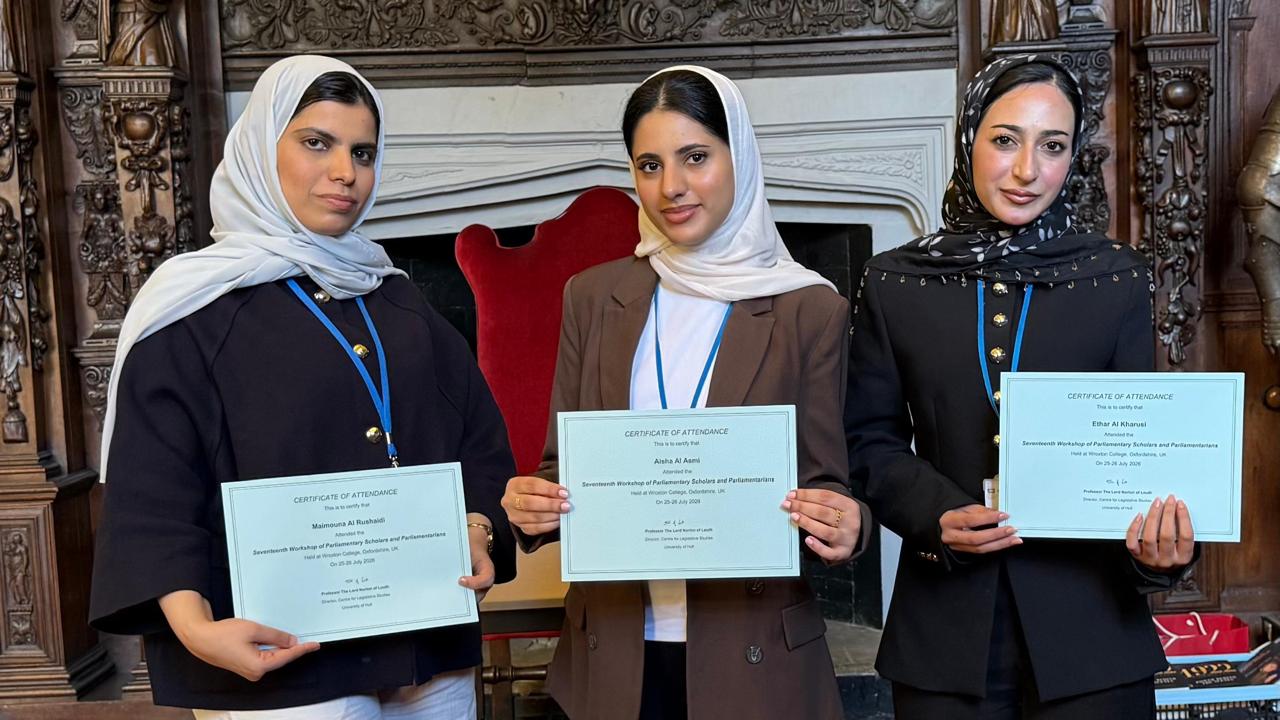
As part of their participation in the Wroxton Workshop, supported by a grant from The British Omani Society, Aisha Al Asmi, Eithar Al Kharousi and Maimouna Al Rushaidi travelled to the United Kingdom to present Oman’s experience in digitalising the electoral process through the Entakheb application.
Participating in the 17th Workshop of Parliamentary Scholars and Parliamentarians at Wroxton College, Oxfordshire, was a highly enriching academic and professional experience. The workshop brought together parliamentarians, scholars, and policy experts from different countries, creating a valuable platform for dialogue on democratic governance, parliamentary practice, legislative oversight, artificial intelligence, cybersecurity, and international cooperation.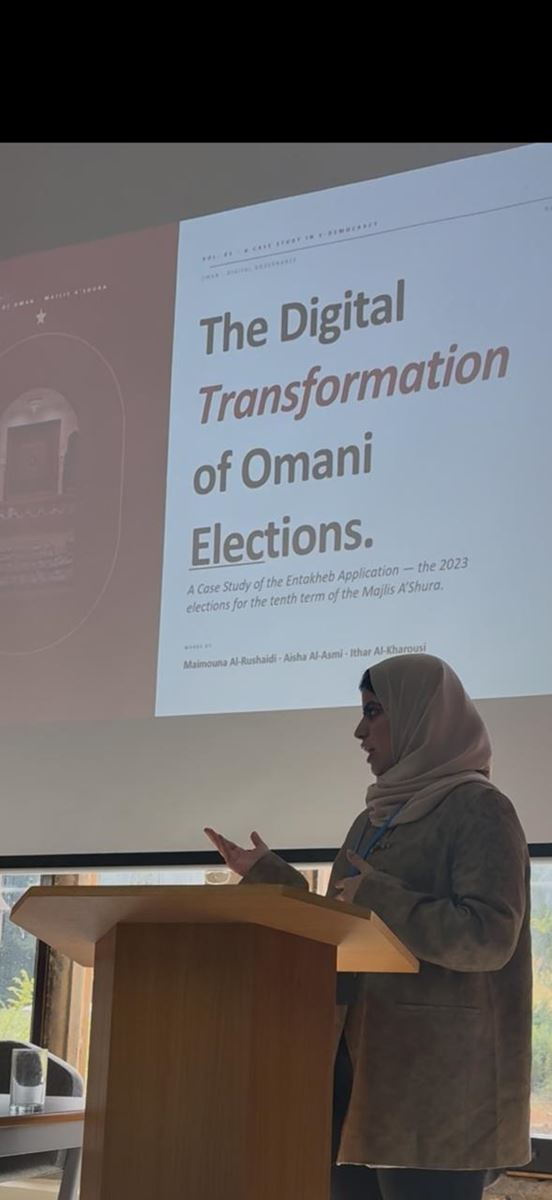
For us, the experience represented more than an academic opportunity. It provided a meaningful platform to share Oman’s experience with an international audience while strengthening connections between Omani and British academic and parliamentary communities. The exchange of perspectives demonstrated how academic engagement can contribute to mutual understanding and to the longstanding friendship between Oman and the United Kingdom.
As part of the workshop, we presented our research paper, “Digital Transformation in Omani Parliamentary Elections: A Case Study of the ‘Entakheb’ Application.” The research examines how digital transformation has reshaped electoral administration and citizen access in Oman, using the 2023 elections for the tenth term of the Majlis A’Shura as a case study.
Our research considers Entakheb not simply as a mobile voting application, but as part of a broader public-sector digital transformation ecosystem involving digital identity, data integration, mobile accessibility, process automation, cybersecurity, and institutional coordination. The study explored the implications of this transformation for accessibility, administrative efficiency, operational effectiveness, and electoral integrity.
Official data indicated the scale of this transformation, with 753,690 registered voters and 496,279 votes cast, alongside published figures indicating reductions in election staffing and operating costs. These findings provided an important basis for understanding how digital technologies can support large-scale public services while maintaining institutional reliability and public trust.
A significant aspect of the research was its contribution to the emerging body of knowledge on Oman’s digital electoral transformation. One of the main challenges was the limited availability of publicly accessible academic and analytical literature on Oman’s experience. Much of the available evidence was institutional and official, requiring us to distinguish carefully between documented evidence and interpretation and to recognise the limitations of the available data. At the same time, this highlighted an important opportunity for further independent academic research, documentation, and international comparative studies of Oman’s digital transformation.
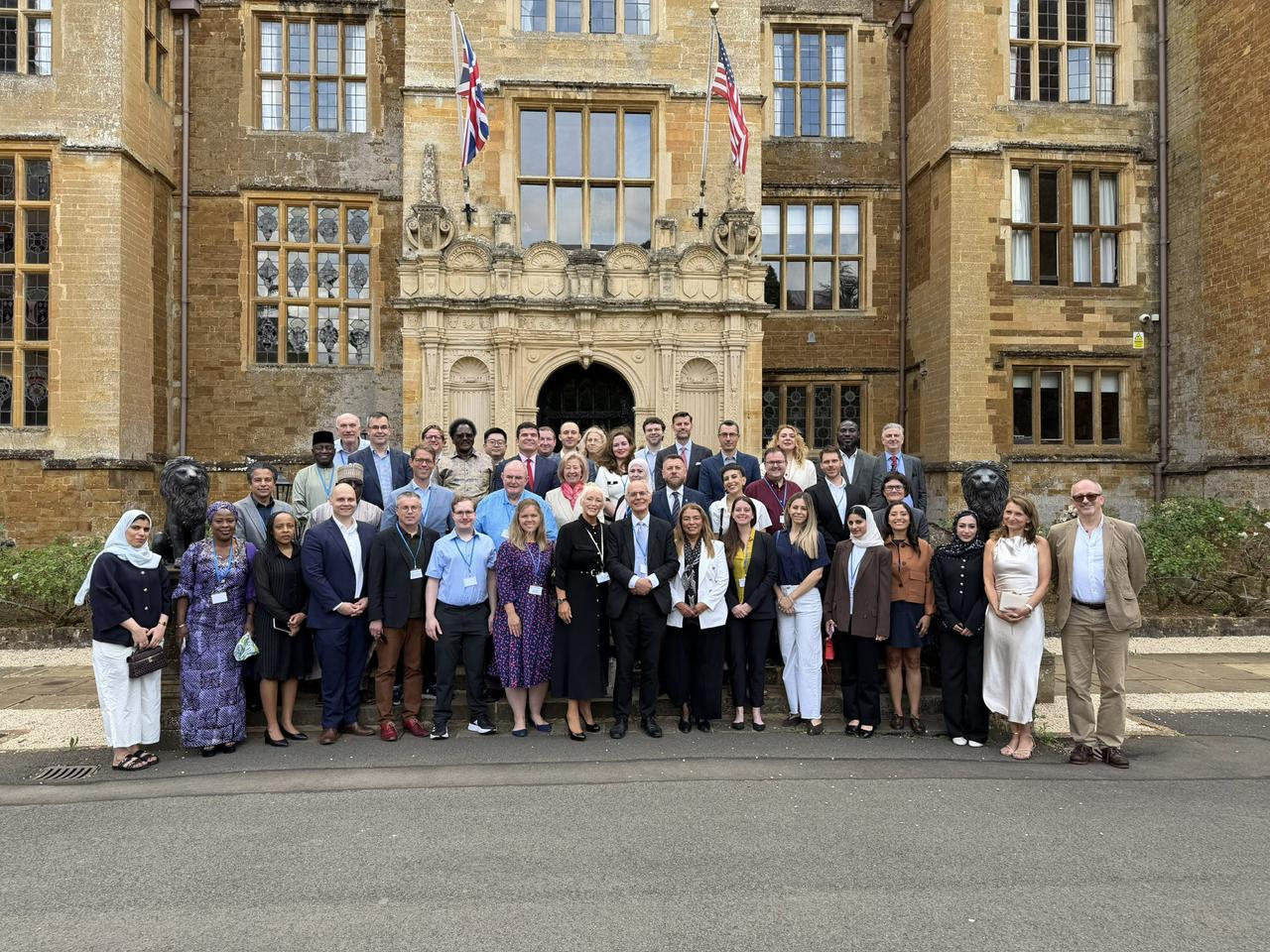
The workshop also provided a valuable two-way exchange of knowledge. British and international scholars and parliamentarians shared perspectives on digital transformation, democratic institutions, cybersecurity, and emerging technologies, while our presentation offered participants insight into Oman’s approach to digital electoral administration. Their questions and discussions encouraged us to examine our research through broader comparative perspectives. The interest expressed by participants, including members of the U.S. delegation, and invitations to share aspects of Oman’s experience in their respective countries, demonstrated the wider relevance of the research.
The benefits of the experience extend beyond the immediate participants. The research and knowledge gained have potential value for researchers, policymakers, parliamentary institutions, public-sector professionals, and scholars interested in digital government and electoral innovation. We also aspire to contribute to wider local dissemination through relevant knowledge-sharing platforms supported by the Ministry of Culture, Sports and Youth, while continuing to share Oman’s experience with international audiences.
The most memorable part of the experience was the journey of discovery. We moved beyond studying an application to understanding the wider institutional ecosystem required to make digital elections possible. This reinforced an important lesson: successful digital transformation is never about technology alone; it depends on trust, inclusion, cybersecurity, transparency, institutional capacity, and continuous improvement.
Personally and professionally, the experience strengthened our ability to question assumptions, communicate complex ideas clearly, engage with diverse perspectives, and connect local experiences with global discussions. It also increased our confidence in presenting Oman’s experience to an international audience while maintaining academic objectivity.
Our key lesson for others considering similar initiatives is simple: embrace the journey, remain curious, and document the experience. Meaningful knowledge is created when practice meets research and when local experiences are given the opportunity to contribute to global conversations.
We extend our sincere gratitude to the British Omani Society for supporting opportunities that connect Oman with international academic and parliamentary communities. Wroxton was more than a workshop for us; it was a journey of knowledge, dialogue, perspective, and connection, creating new opportunities for continued exchange and cooperation and reinforcing the value of sharing Oman’s experience with the wider world.